Every Burr Ridge conversation eventually gets to the county line. Buyers learn early that the village sits in both Cook and DuPage, and that which side of County Line Road a home falls on can shift the tax bill by a real margin. It's a fair thing to flag, and most agents do.
It is not the boundary that actually shows up during an inspection.
The boundary that matters when you're under contract runs through the middle of several residential streets and splits Burr Ridge into three separate sewer and water authorities. Depending on which side of that line a house sits, the age of the pipe under the street, who answers the phone during a backup, and whether a capital project is already underway in that subdivision can look completely different from the house three doors down. None of that shows up on a listing sheet. It shows up at inspection, or worse, six months after closing.
Three Authorities, One Village
The Village of Burr Ridge's own public works division lays out the split plainly. Residents east of County Line Road are served by the Village of Burr Ridge's own sanitary sewer system. Residents west of County Line Road and south of I-55, including Babson Park, fall under DuPage County Public Works. Residents north of I-55 and west of County Line Road are served by the Flagg Creek Water Reclamation District, a separate taxing body entirely.
| Boundary | Authority | Who to Call |
|---|---|---|
| East of County Line Road | Village of Burr Ridge Sanitary Sewer | Village of Burr Ridge Public Works |
| West of County Line Road, south of I-55 (incl. Babson Park) | DuPage County Public Works | DuPage County Public Works |
| North of I-55, west of County Line Road | Flagg Creek Water Reclamation District | Flagg Creek Water Reclamation District |
These three bodies bill separately, maintain separately, and cannot accept payments or service requests on each other's behalf. If you buy a house without knowing which line you're on, you find out the hard way, usually while standing in a flooding basement trying to figure out who to call.
The village makes the process simple for its own residents. Before dispatching a plumber for a main line issue, homeowners east of County Line Road are asked to call the village directly during business hours, or 911 after hours, so staff can check whether the blockage is in the public main. If it is, the village clears it at no cost. If the main is clear, the problem is in the private lateral, and that's on the homeowner. That single phone call can save a service fee, but only if you know to make it, and only if you know which authority actually owns the pipe you're calling about.
What's Actually Underground Depends on the Subdivision
Burr Ridge's infrastructure is not uniform in age or condition, and the village's own project records make that clear. The Carriage Way subdivision is currently mid-project, with water main replacement and sanitary sewer rehabilitation underway after the village board awarded a contract to Trine Construction Corp. for just over $3.35 million. A separate stretch at 62nd Street and Cove Creek Court needed a full water main replacement after the area recorded 16 water main breaks in two years, a frequency that pushed the project past routine maintenance.
Age plays a role too. In neighborhoods like Ambriance and Highland Fields, and along the corridors near Plainfield Road, decades of mature oak, maple, and cottonwood growth mean root systems that travel 40 to 60 feet from the trunk have had 30 to 50 years to find their way into aging sewer lateral joints. That kind of intrusion rarely announces itself with a sudden backup. It shows up first as a drain that slowly gets sluggish over a year or two, then needs more frequent rodding just to keep functioning, long before anyone thinks to call it a structural problem.
None of this means a given subdivision is a red flag. It means the due diligence question changes depending on the address. A home in a subdivision with an active capital project is being addressed by the village. A 40-year-old lateral in a heavily wooded lot that has never had a camera inspection is a different conversation entirely, and it's one worth having before you write an offer, not after your first rodding bill.
The Pump Center Behind All of It
Every drop of water reaching a Burr Ridge tap traces back to one facility. The village receives treated Lake Michigan water through a transmission main from Bedford Park, and its own Pump Center disinfects, stores, pressurizes, and distributes it from there. Burr Ridge was the first municipality in DuPage County to deliver Lake Michigan water to every customer, a distinction it earned back in 1984, which also means the Pump Center handling that supply today is roughly 40 years old.
The village is in the middle of a multi-phase modernization of that facility, replacing flow meters, piping insulation, and aging pump motors, and reprogramming the control systems that monitor the whole operation. Phase 1, covering HVAC upgrades to protect the electronics, is underway now. Phase 2, which will install variable-frequency drives and a modernized motor control center, is budgeted for the village's FY2027 cycle. This is not a project a buyer needs to track line by line. It's context for why the village's own infrastructure has been surfacing age-related issues across multiple subdivisions at the same time. The system is being addressed, but it's being addressed because it's old, and that age doesn't stop at the property line just because the pump station is village-owned.
The Building Boom Left Its Own Fingerprint
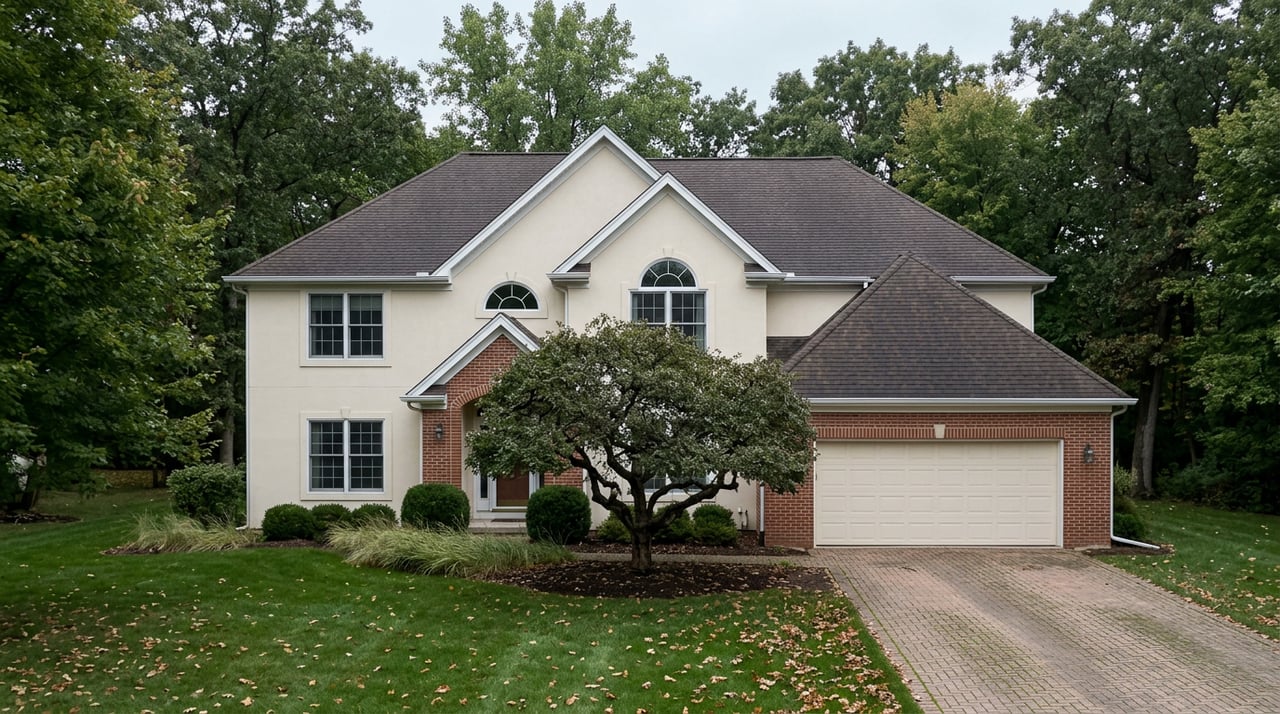
Burr Ridge's estate-scale housing stock largely dates to a building boom in the 1990s, and that era left a specific inspection issue behind for a certain kind of home. Many of the larger custom estates from that decade were clad in EIFS, the synthetic stucco system also known by the brand name Dryvit. Properly installed and maintained, it performs well and holds up for decades. Left unmaintained, it can trap moisture behind the wall assembly in ways that aren't visible from the curb and don't show up on a standard walkthrough.
This is a different kind of risk than the sewer and water questions above. It's not about which authority serves the parcel. It's about the specific vintage of home and its exterior material, and it's worth asking about directly if you're looking at a larger estate built during that era, particularly one that hasn't had a documented moisture inspection.
Before You Close on a Burr Ridge Home
Given a median sale price in the $1 million to $1.2 million range as of mid-2026 depending on the data source, and homes typically moving in well under two months, the margin for a surprise at closing is smaller than the sticker price might suggest. A few questions are worth settling before an offer goes in, not after:
- Confirm which sewer and water authority actually serves the parcel, and save the contact information for that specific body, not just the village's general line.
- Ask whether the subdivision has an active or recently completed water main or sewer capital project, and if so, what that means for the home's specific service line.
- For any home over 20 years old, request a camera inspection of the private lateral rather than relying on a standard rod-out. If it's clean, you've bought real peace of mind. If it isn't, you've found the problem before it finds you.
- For homes from the 1990s building boom with stucco or synthetic exterior finishes, ask specifically about EIFS moisture testing history.
- Understand that public infrastructure stops at the property line. Everything from the foundation to the main, including the lateral itself, is the homeowner's responsibility once you close.
A Few Questions Worth Asking
How do I find out which sewer district actually serves a specific address in Burr Ridge? The village's public works division maintains the boundary lines and can confirm which of the three authorities serves a given parcel. It's a quick call worth making before you write an offer, not after.
Is EIFS the same thing as traditional stucco? No. Traditional stucco is a hard cement-based coating applied directly over a substrate. EIFS, often sold under the brand name Dryvit, is a synthetic system with a foam insulation layer beneath a thin, flexible finish coat. The two look similar from the street but behave very differently when moisture gets behind them, which is why a home's exterior material is worth confirming rather than assuming.
What should I do if a sewer backup happens after I've already moved in? If you're east of County Line Road, call the Village of Burr Ridge's public works line first, during business hours, or 911 after hours, before you call a plumber. Village staff can check whether the issue is in the public main, and if it is, they'll clear it at no cost. If the main is clear, you're looking at your own private lateral, and that's the point to bring in a plumber.
Burr Ridge rewards buyers and sellers who ask the right question at the right moment, and punishes the ones who assume every estate in the village sits on the same infrastructure. If you're weighing an offer or preparing to list, Afrouz Kameli can help you sort out exactly which lines, districts, and vintage-specific questions apply to your address before they become closing-week surprises. Let's Connect.